
A bad Chinese tattoo is not always wrong because the dictionary translation is wrong. Sometimes the words are understandable, but the feeling is off.
Maybe the phrase sounds like a machine translated it. Maybe the character choice is too dramatic. Maybe the font looks like a takeout menu. Native speakers may still understand it, but they will also immediately feel that something is strange.
If you are about to put Chinese characters on your body, slow down for one more check. Meaning matters, but so do tone, flow, and visual style.
Before you ink it
Already have Chinese characters or a phrase in mind?
Don't leave it to guesswork. Run it through our free Tattoo Text Checker for a quick safety check on meaning, tone, flow, and tattoo fit.
1. The Literal Translation Trap
English phrases do not always survive direct translation. A phrase can feel strong in English and oddly flat, funny, or commercial in Chinese.
Take something like "live free." The English phrase points to freedom and independence. But if someone treats "free" like "no cost," the Chinese result can drift toward the feeling of "free living" or "living for free." That is not a life motto anymore. It starts to sound like a discount poster.
This is the kind of mistake that happens when the tool sees words but not context. Before tattooing a phrase, ask what it sounds like to a person, not just what each word means.
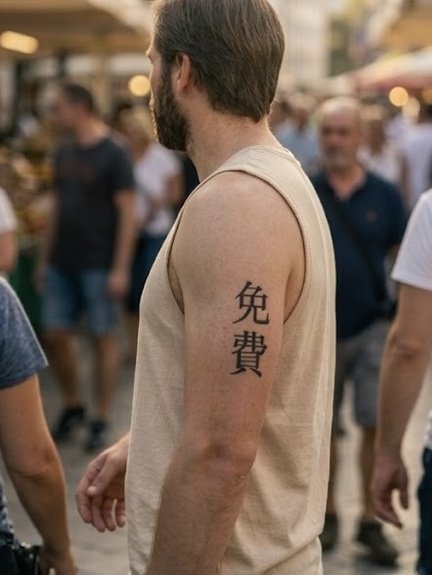
"Bro literally tattooed 'FREE-OF-CHARGE' on his arm. Is he on sale?"
"Imagine walking around with 'no charge' on his arm. Did he want a discount or something?"
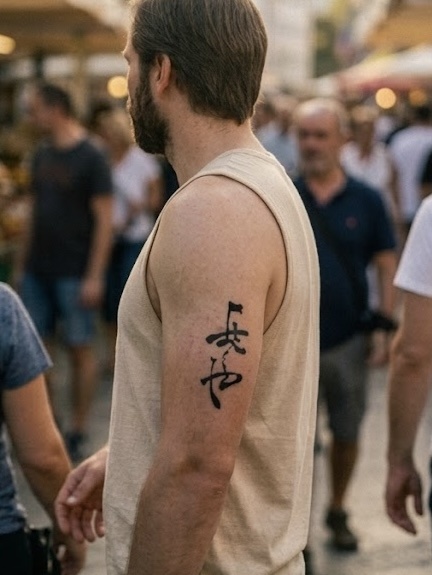
Instead of a literal translation like "免费" (which means free-of-charge or no cost), a native Chinese speaker would use "自由" to represent freedom, liberty, and a free spirit. Written in an elegant, hand-brushed calligraphic style, it conveys a personal philosophy of independence rather than looking like a supermarket discount tag.
Quick examples
5 literal tattoo translation risks
These are better directions, not final tattoo advice. Always check meaning, tone, and calligraphy before inking.
English idea
"Live free"
Sounds like living for free or a discount ad, not a life philosophy.
English idea
"Be strong"
Sounds like sturdy furniture, physical bulk, or a bulky body type, not inner strength.
English idea
"Free spirit"
Sounds like a free-of-charge spirit, not an independent soul.
English idea
"Protect my peace"
Sounds political or literal, not like emotional boundaries.
English idea
"Stay wild"
Sounds like keeping an animal undomesticated, not living freely.
2. The Word Is Close, but the Vibe Is Wrong
This one is sneakier because the translation may not be technically false.
Say someone wants a tattoo that means "strong." A dictionary might lead them toward words like 结实 or 粗壮. These can describe sturdiness or physical bulk, but as a tattoo they feel heavy and awkward. 结实 can sound like sturdy furniture or a solid body type. 粗壮 can sound bulky, thick, or muscular in a not-very-poetic way.
That may be fine if you are describing a table leg. It is probably not the emotional meaning you wanted on your skin.
3. The Phrase Sounds Like Translation, Not Chinese
Native speakers can often tell when a Chinese phrase began its life as an English sentence.
It may use the right characters but the wrong rhythm. It may be too long. It may say the obvious part out loud. It may sound like someone asked software to translate a motivational poster.
Chinese motto-style wording tends to be compact. It often favors balance, restraint, and layered meaning. If your phrase needs a long explanation to stop sounding strange, it is not ready for a tattoo yet.
4. The Meaning Is Too Dramatic
A lot of tattoo ideas start with words like destiny, warrior, eternal, fearless, power, soul, or victory. There is nothing wrong with wanting something meaningful. The problem is that Chinese can make overly dramatic wording feel even more intense.
A phrase that sounds bold in English may feel like a fantasy character title in Chinese. Or like an internet username. Or like something printed on a cheap phone case.
A good Chinese motto usually does not need to shout. It can be quieter and still be strong.
5. The Characters Look Cool, but the Name Feels Random
Some people pick Chinese characters because they look beautiful on the page. That is understandable, but characters are not decorations first. They carry sound, meaning, and cultural associations.
This matters even more for a Chinese name tattoo. A name should feel like a name. It should have a natural structure, smooth pronunciation, and a meaning you can explain without sounding unsure.
If you do not have a Chinese name yet, do not build a tattoo from random characters. Start with a name that can actually work in Chinese.
6. The Font Looks Like a Menu
This is the mistake people underestimate the most.
If you tattoo Chinese characters in a default computer font like SimSun or a plain black system font, many native speakers will read it the way English speakers read a word tattooed in Times New Roman or Arial Bold. It may be legible, but it feels stiff, cold, and unchosen.
In the worst cases, it gives supermarket receipt, office document, or takeout menu energy. That is not the mood most people want from a permanent tattoo.
If the wording is personal, the visual treatment should be personal too. Think brush-style lettering, custom calligraphy, balanced spacing, and a tattoo artist who understands how to preserve the character structure.
7. Nobody Checked It Like a Native Speaker Would
The final mistake is simple: people fall in love with an idea and skip the boring safety check.
Before you get a Chinese tattoo, check five things:
- Meaning: Does it mean what you think it means?
- Tone: Does it feel natural, serious, poetic, or weirdly intense?
- Flow: Would someone actually say it this way?
- Character system: Are simplified and traditional forms used consistently?
- Visual fit: Does the font or calligraphy look intentional?
Before it becomes permanent, paste your Chinese name, phrase, or motto into the free Tattoo Text Checker for a quick meaning, tone, flow, and visual-style check.
A Better Order: Meaning First, Ink Later
The safest path is not to pick characters because they look mysterious. Start with the reason you want Chinese on your body.
If it is about identity, start with a Chinese name that sounds natural and carries meaning. If it is about a life principle, shape a short motto that actually feels like Chinese. If it is a quote or phrase, be extra careful, because that is where translation mistakes show up fastest.
A Chinese tattoo should be something you can explain comfortably years from now. Not just "I liked the way it looked," but "This is what it means, this is why it fits me, and this is why the wording makes sense."
Check the words before they become permanent
Already have tattoo text? Check it first. Still choosing a Chinese name or motto? Start with a meaningful Chinese name, then review the wording before taking anything to an artist.


